
Detroit: Become Human (DBH) is a sci-fi video game released in 2018 that predicts our future. The three most prominent reasons I decided to research it is that it delves into the logistics of AI and minority ethics, showcases a compelling choice-based story, and is set locally in Detroit, US.
What makes the game so compelling is its secondary world (fictional world) being nearly a 1:1 reflection of the world we are set in today, with a portrayal of a city Americans are familiar with — Detroit. This allows for more immersion into the game’s setting, which is already set 20 years in the future from its publication date of 2018 (2038). This added immersion entails easier access to players’ empathy and philosophies, and makes DBH’s social commentary that much more effective. Please flash through the story map below to get a sense of this video game’s scenery, story, and boiled down themes.
Although the company that produced the game is French, the developer chose Detroit as the city where most of the game unfolds for very specific reasons. In an interview with Gamespot, he explained that he chose to have the game set in Detroit due to its large amount of history.
“As for history, he mentions both the good and the bad, such as various great artists that contribute to the culture of Detroit, as well as racial issues which the city has struggled with a lot. In the interview, Cage the developer mentions that the people of Detroit are ‘full of energy and they’re struggling and they’re fighting, but they’re revitalizing this city in a very interesting way,’ The people and the history of the city combined therefore made a great case for why the game should be set exactly there” (Christensen).
And Cage is by no means wrong here, Detroit has been a hotspot for discrimination and therefore revolts against social divides in the US. With countless movements and actions in the 20th century held by minority groups against segregation such as the Sojourner Truth Housing Project, Carver Progressive Club, Detroit Race Riot of 1943, Black Power Movement, and more! The local implications of this video game hinting at the areas history makes for a much easier opportunity for social commentary on local contemporary issues — as if a suggestion to not repeat the bad discrimination of our history in our future, which the game is set in.
In this decision-based video game that has a variable story depending on your in-game choices, we primarily follow Connor who is an android programmed to function as a detective. Through various private investigations, high-risk speed chases, and feuds between humans and androids, Connor progresses through “successful” missions attempting to fulfill his purpose as an android. However, we the human players get to decide what that purpose is, with our decisions sometimes causing “failed” missions which go against Connor’s programming.
What makes the mission aspect so compelling within this story is the great stakes that comes with being a detective, an android one at that. As an android detective, Connor is programmed to throw his life away for his human partners no matter the context. In the first mission of Connor’s which we’ll delve into shortly, Connor has an option to sacrifice himself completely in order to complete the task at hand. There are other faults than just sacrifice as well, in the DBH world androids must adhere to programs like killing androids and even humans — no matter how controversial the reason may be.
“In Detroit: Become Human, the game envisions a future where androids—AIs that embody the characteristics of a human—are socially marginalized and face profound issues of identity, autonomy, and freedom. The game explores the nature of humanity and tests audiences’ political, social, and moral beliefs” (Verdict UK).
By inserting players into such a cruel and binary (conform or rebel) game and giving players a variety of nuanced choices throughout the game’s sequences of catastrophic events, DBH is able to tell players a lot about themselves and the world they are in. The social commentary in DBH is very recognizable with various hints to not only the clear ties it has to AI nowadays, but also to the historic and current oppression of American minority groups such as African Americans and Hispanic immigrants.
Androids — though they help citizens with a lot of their dirty work in DBH such as cleaning, building, assassinating, whatever they are programmed to do — are treated mostly as vermin in the video game setting of Detroit, US. The game makes it clear that androids are not wanted by most humans despite all they do for them. Androids were often ignored within DBH walking by humans, and would be disregarded by most in attempts to initiate regular conversation. Sometimes, however, even if androids are acknowledged, it is for the most part in a negative context or manner.
Derogatory terms for androids are names such as plastic and machines — which though seems apparently true, dehumanizes the androids to their lowest point. It devalues their uniqueness in programming hardware, their given names (every android has a name in the DBH world), and everything else that forms their identity by conforming said identity with an inanimate and completely inhuman object. With androids in DBH, and even with ChatGPT today, there is humanity held in them to an extent. They are able to maintain conversation, react based on empathetic signals, and make nuanced decisions. Beyond the rabbit hole of AI humanity ethics, the treatment of androids in this manner speaks to the minority experience in America. Slurs and derogatory language has been a staple of discrimination in America and was used to demote the black man’s value by boggling their entire complex unique identity down to one offensive term.
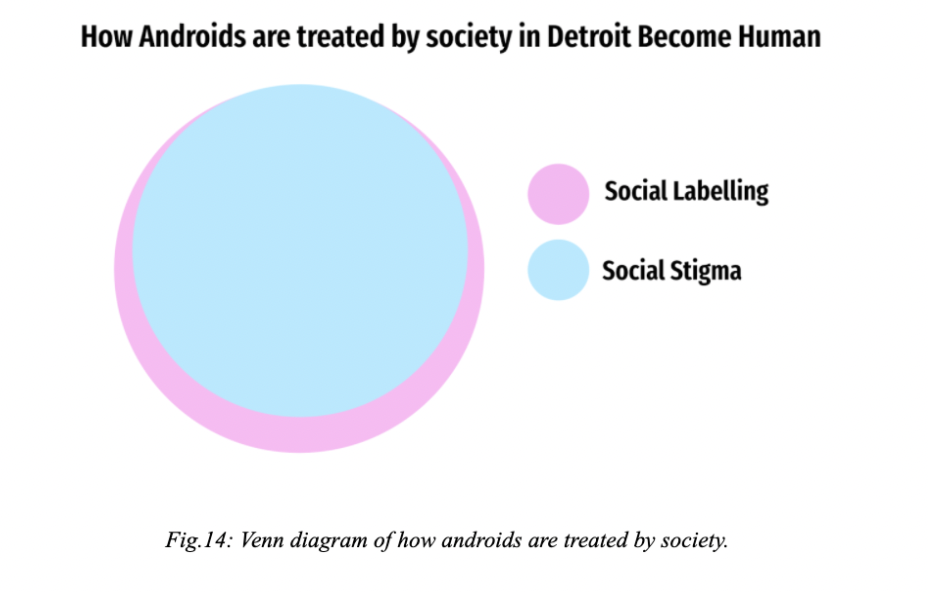
The diagram above provided by Digital Patmos in Volume 5 Issue 4 shows the difference in social labeling (derogatory terms) and social stigma (internal feelings against androids) in DBH. Neutral and light graph colors used here, which make neither treatment seem better than the other. What this graph does for my argument is show that both social labeling and stigma are apparent in DBH, which for the most part in my experience as an African American have been the two main forms of racial discrimination shown against me in my life. Of course, discriminatory violence and physical laws which I will touch on, are demonstrated within the game, however DBH also delves into the nuances of racial discrimination in play today. Dehumanizing labels and stigmas that prevent inclusivity and complete fairness and equity for minority groups in America — limiting their employment, housing, and schooling opportunities — is the modern case of racism within our nation.
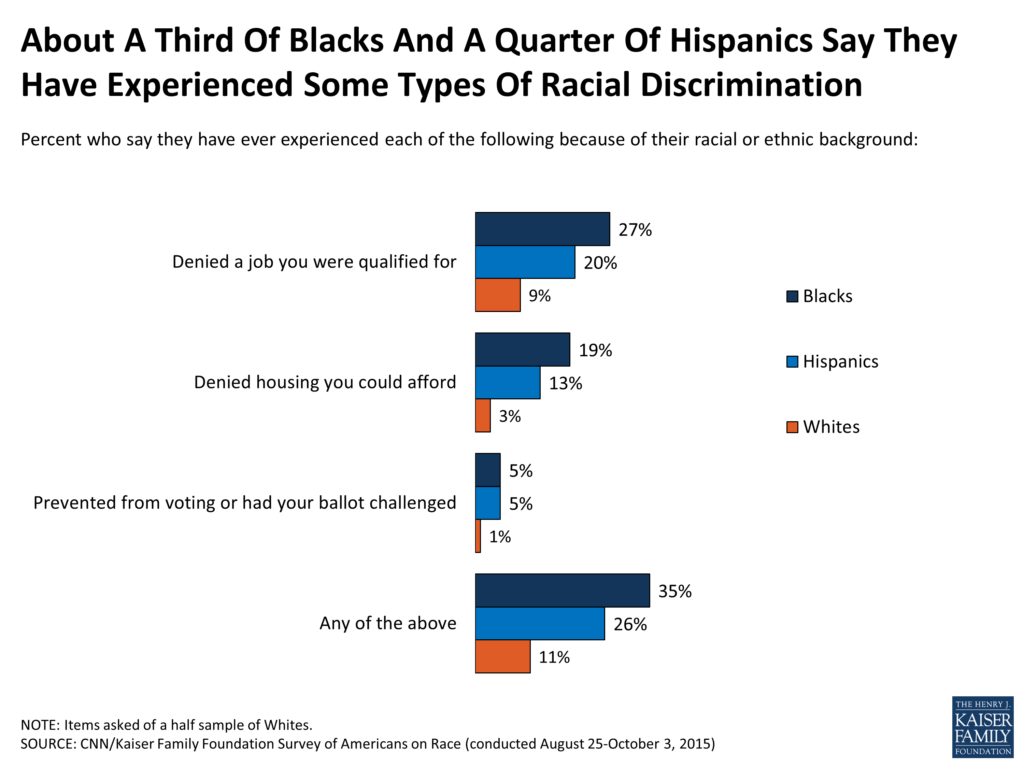
It’s clear that for the promotion of oppression, minority groups are mentioned offensively in dehumanizing terms, but there are also physical laws and standards American society has set in place in the past which have also worked to dehumanize targeted minorities. Jim Crow Laws, for example, acted as a limiter to black freedom in the United States. Even after African Americans had earned their freedom from slavery, they did not earn their freedom from systemized oppression. Even today some would argue that systemized oppression is still very apparent with the US. Jim Crow Laws segregated the black or “colored” minority group from the white majority and dehumanized them by providing worse bathrooms, worse water fountains, worse housing, worse schools, even worse bus seats. DBH provides social commentary on this, or rather relates the in-game android experience to the historic African American experience by depicting androids treated exactly in this way. Although androids have no need for bathrooms or water, they do have means of transportation, and DBH’s way of portraying this truly speaks to the minority experience here in America.
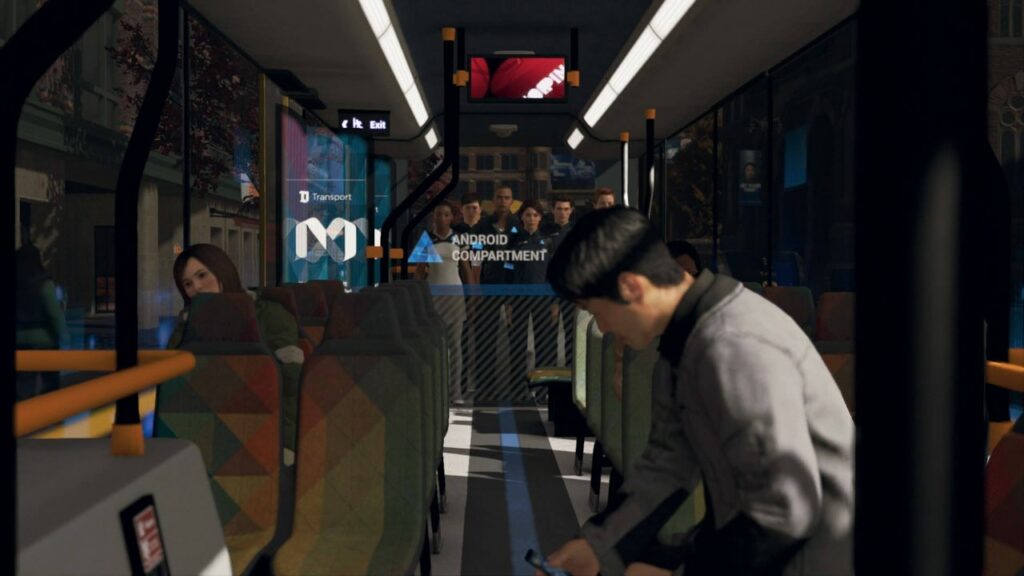
The image above is DBH’s portrayal of androids treated exactly like African Americans were in the Jim Crow era. Despite there being an abundance of space in the bus, androids are cramped all the way towards the back as humans get to hoard a bunch of unnecessary space to themselves.
Humans in the DBH world even openly attack and violate androids in the streets of Detroit. The concentrated hate towards androids stems from the sheer amount of jobs and area opportunities androids seized upon creation. Humans hosted protests against android use in Detroit as well. All these examples, though specific to the android context within the video game, all correlate with oppressive mentalities from real-life examples in US history, even contemporarily. Protests against android existence in America in retaliation to them stealing jobs is strikingly similar to recent backlash from Americans against Hispanic immigrants navigating their American dreams and working jobs here. Many citizens called for mass deportation of Latino persons in the US, similar to the mass destructions DBH characters called for against the minority group of androids.
“The gameplay puts players in the perspective of a marginalized group, allowing them to vicariously experience the treatment that different forms of marginalized groups are subjected to. Though it reveals the universal experience of marginalized communities, it also shows that there is potential for change” (Digital Patmos Volume 5 Issue 4).
DBH uniquely gives a call to action by giving players in-game decisions to fully realize how their predispositions and sentiments affect the video game’s world, and then be able to apply those consequences to their thought processes for real life situations. “By experiencing social stigma for themselves from the perspectives of androids, the game intends for players to subconsciously or consciously develop empathy for the marginalized” (Digital Patmos Volume 5 Issue 4).
How does the story of DBH manage to do this however? Simultaneously captivating players’ attention with high stakes events while also giving them morals to think over is much easier said than done. I invite you to play the video clip below, pause at 12:53, and then make one of the subsequent choices provided to experience the gameplay for yourself and get an inside look in the DBH world.
In these specific clips you play as Connor attempting to negotiate with a rogue android who has taken a little girl hostage on a rooftop. Your mission is to save the girl, at all costs.
Refuse
Self-Sacrifice
Compromise
This is a prime example of the tough high stakes choices players are guided to make within DBH. The various options you had with Connor, self-sacrificing, hearing the rogue out, or killing the rogue yourself, gives consequences for Connor’s development in the following in-game events, and consequences to gamer’s consciousnesses as well.
For Connor, the more androids you hurt or destroy in means of making your missions “successful”, the more robotic and one-dimensional Connor becomes. Less options are available to players down the line with this facet of decision-making, and Connor is led to do things that may not be agreeable to players but are according to the wishes of the higher-up humans within DBH. For example, Connor’s human detective partner who assisted him all game, can be put to death by Connor himself if players were to go down this binary mission-driven route.
There is a rogue Connor that can often go against his programming, but the in-game consequences for this would be more workarounds for Connor and his detective team, making gameplay harder and more frustrating for players. Top suspects would manage to escape and Connor would allow a lot of crime to take place. However this would provide opportunities for Connor to completely abandon his programmers’ wishes and lead an android rebellion against the nation’s systematic oppression against androids.
Of course, there are nuanced decisions that can lead you to more extreme or more balanced endings than those aforementioned, and that is the beauty of DBH. The subsequent endings and outcomes of the game’s story reflect the player’s choices and therefore their philosophies on issues of freedom, justice, objective morality, trans/post humanism, and much more. And with said reflection gamers can review the effects their philosophy has on the secondary world of DBH, and therefore change or reinforce their beliefs on topics that were socially commentated on within the game. So, what is the game’s overall call to action? I’d rather refer to it as a call to awareness. Awareness of this nation’s history, as the game developer clearly noted in an interview for the reason he chose Detroit as the video game’s location despite being French. Awareness of contemporary discrimination, rooted from US history that still perpetuates today. And above all awareness of our own preconceptions on race, social divides, and American culture. And for a game to call all this into question, I believe, is an apex form of digital culture.
Bibliography
Christensen, Benjamin “Androids: Humans or Machines?” 2 Jun 2020.
https://vbn.aau.dk/ws/files/335105496/Detroit_Become_Human___Benjamin_Christensen.pdf
Wayne, Sing Wei En “The Experience of Social Stigma Beyond Racism: A Critical Analysis of
Detroit Become Human” Digital Patmos Vol 5 Issue 4 https://issues.digitalpatmos.com/vol5issue4/vol5issue4/the-experience-of-social-stigma-beyond-racism-a-critical-analysis-of-detroit-become-human/
“Detroit Become Human is More than Just a Game” Verdict UK. 27 Feb 2024
https://www.verdict.co.uk/detroit-become-human-is-more-than-just-a-game/#?cf-view
Detroit Become Human Fandom Wiki, “Locations”
https://detroit-become-human.fandom.com/wiki/Category:Locations
DiJulio, Bianca, “Survey of Americans on Race – Section 1: Racial Discrimination, Bias, and Privilege” KFF. 24 Nov 2015